Loading...
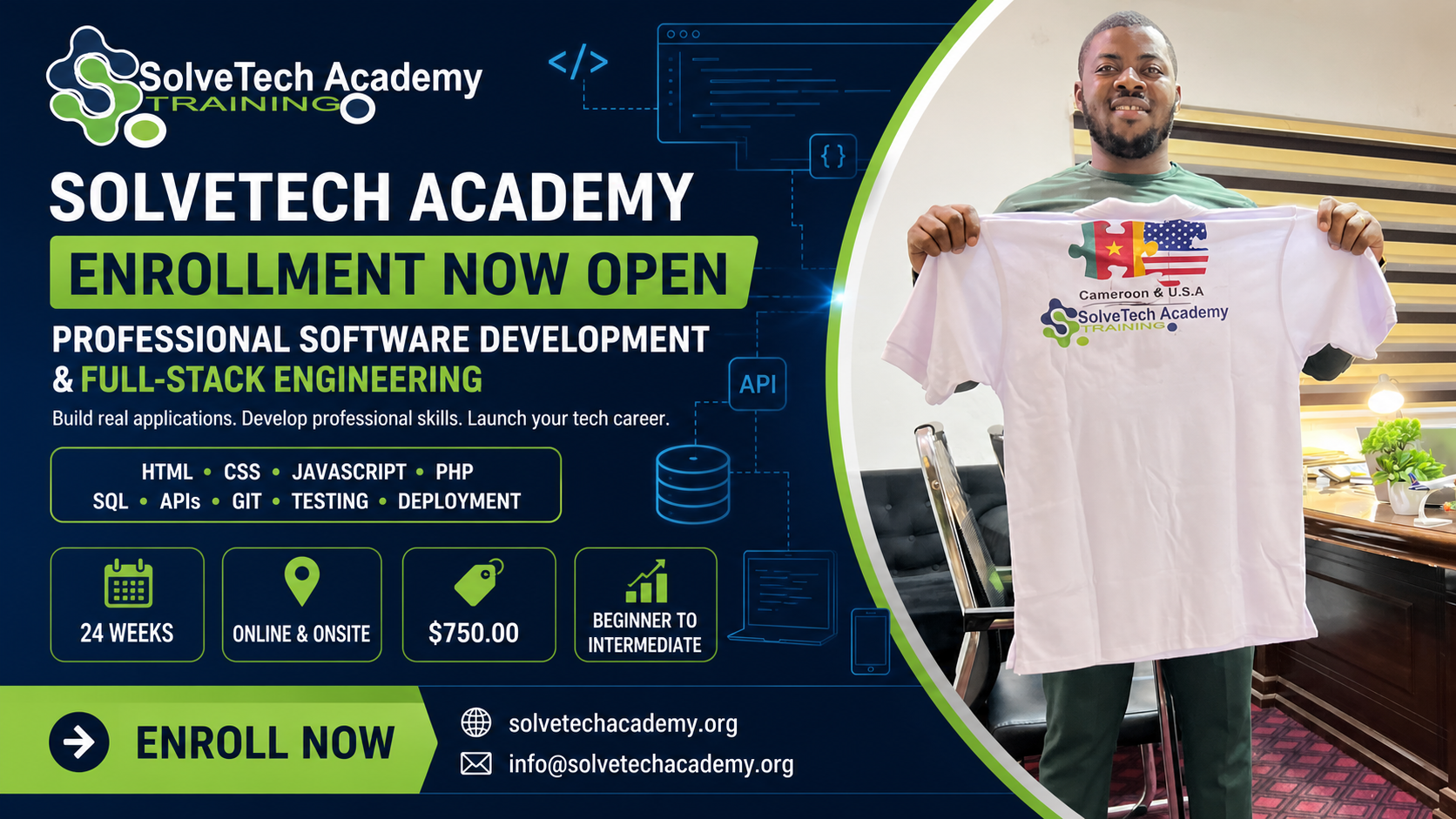
Professional Software Development & Full-Stack Engineering

Professional Software Development & Full-Stack Engineering

Category: Software Development

Instructor: Engr. Raoul Timah

Duration: 24 Weeks (6 Months)

Level: Beginner

Mode: Online

Price: $84.23

Enroll Now

About This Course

The Professional Software Development & Full-Stack Engineering course is a comprehensive, practical program designed to equip learners with the technical and problem-solving skills required to design, build, test, deploy, and maintain modern software applications.
Students begin with programming fundamentals, computational thinking, algorithms, data structures, and version control. They then progress into front-end web development using HTML, CSS, JavaScript, responsive design, accessibility, and modern user-interface practices.
The back-end section introduces server-side programming, application architecture, authentication, database design, SQL, APIs, validation, security, and error handling. Students learn how front-end applications communicate with servers and databases to create complete full-stack systems.
The program also covers Git and GitHub, debugging, automated testing, object-oriented programming, software design principles, documentation, Agile development, teamwork, deployment, maintenance, and introductory DevOps practices.
Throughout the course, learners complete coding exercises, module assignments, quizzes, collaborative activities, and portfolio projects. The course concludes with a capstone project in which each student plans, develops, tests, documents, deploys, and presents a complete software application.

What You'll Learn

  • By the end of the course, students should be able to:
  • Explain fundamental programming and software-development concepts.
  • Break complex problems into logical programming steps.
  • Use variables, data types, operators, conditions, loops, and functions.
  • Apply object-oriented programming principles.
  • Work with common data structures and algorithms.
  • Build structured and accessible webpages using HTML.
  • Create responsive layouts using CSS.
  • Develop interactive applications using JavaScript.
  • Apply responsive and mobile-first design principles.
  • Use Git and GitHub for version control and collaboration.
  • Design relational databases and write SQL queries.
  • Develop secure server-side application functionality.
  • Build and consume RESTful APIs.
  • Implement registration, authentication, authorization, and sessions.
  • Validate and sanitize user input.
  • Apply secure coding and data-protection practices.
  • Handle application errors without exposing sensitive information.
  • Write unit, integration, and functional tests.
  • Debug and troubleshoot software problems.
  • Apply software architecture and design principles.
  • Document application requirements, APIs, code, and deployment procedures.
  • Work effectively within an Agile software-development team.
  • Deploy applications to a production hosting environment.
  • Monitor, maintain, and improve deployed software.
  • Build and present a professional full-stack capstone project.

Career Opportunities

  • Graduates may pursue entry-level and junior opportunities such as:
  • Junior Software Developer
  • Junior Full-Stack Developer
  • Front-End Developer
  • Back-End Developer
  • Web Application Developer
  • Junior PHP Developer
  • Junior JavaScript Developer
  • Application Support Developer
  • Software Support Engineer
  • Website Developer
  • Content Management System Developer
  • Database Support Assistant
  • Quality Assurance Assistant
  • Junior Software Tester
  • Technical Support Specialist
  • Implementation Support Developer
  • Freelance Web Developer
  • Graduates can also provide freelance services such as:
  • Business website development
  • Web application development
  • Website maintenance
  • Database development
  • API integration
  • E-commerce website development
  • Bug fixing and troubleshooting
  • Responsive website improvement
  • Content management system customization
  • Application deployment and hosting support
  • Software documentation and testing
  • With additional experience and advanced study, graduates may progress toward positions such as:
  • Software Engineer
  • Full-Stack Engineer
  • Front-End Engineer
  • Back-End Engineer
  • Mobile Application Developer
  • API Developer
  • Database Developer
  • Cloud Application Developer
  • DevOps Engineer
  • Quality Assurance Engineer
  • Software Architect
  • Engineering Team Lead
  • Technical Consultant
  • Graduates may work in technology, finance, healthcare, education, telecommunications, government, retail, logistics, nonprofit organizations, consulting, and software-development companies.
  • Career outcomes depend on practical competence, portfolio quality, experience, location, and employer requirements. Course completion does not guarantee employment.

Prerequisites

  • Students should have:
  • Basic computer literacy.
  • Ability to use a web browser, email, and common computer applications.
  • Basic proficiency in written and spoken English.
  • Access to a reliable computer.
  • Reliable internet access for online learning and development tools.
  • Willingness to learn programming and solve technical problems.
  • Ability to dedicate regular time to coding exercises and projects.
  • Previous programming experience is not required. Prior exposure to mathematics, web technologies, or information technology may be helpful but is not mandatory.

Who Should Take This Course?

  • This course is suitable for:
  • Beginners seeking a career in software development.
  • Students and recent graduates.
  • Individuals transitioning into the technology industry.
  • Aspiring front-end developers.
  • Aspiring back-end developers.
  • Aspiring full-stack developers.
  • Entrepreneurs who want to build digital products.
  • Business owners interested in understanding software development.
  • Information technology support professionals.
  • Designers who want to add programming skills.
  • Freelancers seeking web-development opportunities.
  • Professionals interested in application development and automation.
  • Anyone willing to learn programming through practical projects.

Certificate Information

Certificate of Completion in Professional Software Development & Full-Stack Engineering
Students who successfully complete the program requirements will receive a digitally verifiable SolveTech Academy Certificate of Completion.
To qualify for the certificate, a student must:
Complete at least 80% of the required lessons.
Submit all compulsory programming assignments.
Complete the required module quizzes.
Obtain an overall course score of at least 70%.
Pass the final examination.
Complete and pass the full-stack capstone project.
Present or demonstrate the completed application where required.
Satisfy all academic and administrative requirements.

Course Preview

Curriculum preview

1. Programming Logic and Software Design2 lessons
2. Data Structures, Databases and APIs2 lessons
3. Frontend and Backend Application Development2 lessons
4. Testing, Version Control and Secure Coding2 lessons
5. Deployment, Maintenance and Team Delivery2 lessons

Delivery & certification

Format: Self-Paced

Instructor: Engr. Raoul Timah

Level: Beginner

Certificate: Certificate of Completion in Professional Software Development & Full-Stack Engineering Students who successfully complete the program requirements will receive a digitally verifiable SolveTech Academy Certificate of Completion. To qualify for the certificate, a student must: Complete at least 80% of the required lessons. Submit all compulsory programming assignments. Complete the required module quizzes. Obtain an overall course score of at least 70%. Pass the final examination. Complete and pass the full-stack capstone project. Present or demonstrate the completed application where required. Satisfy all academic and administrative requirements.

Related courses

Professional Mobile Application Development with Flutter

Design, build, test and publish cross-platform mobile applications with Flutter and Dart.

View course