Loading...
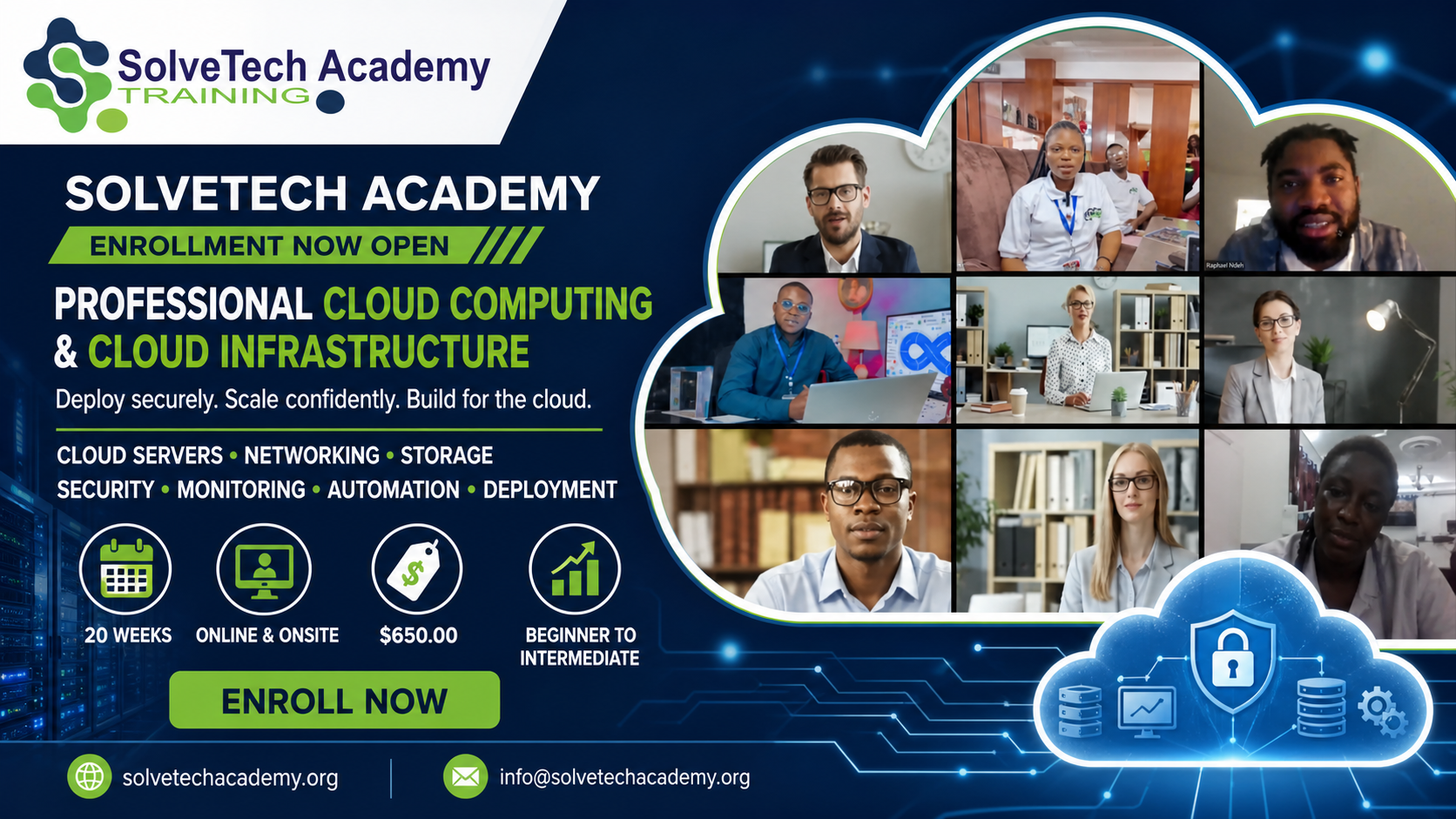
Professional Cloud Computing & Cloud Infrastructure

Professional Cloud Computing & Cloud Infrastructure

Category: Cloud Computing

Instructor: Engr. Nkam Valery

Duration: 20 Weeks

Level: Beginner

Mode: Online

Price: $140.00

Enroll Now

About This Course

The Professional Cloud Computing & Cloud Infrastructure course is a practical training program designed to equip learners with the skills required to deploy, configure, secure, monitor, and maintain cloud-based systems.
Students begin with cloud-computing fundamentals, service models, deployment models, virtualization, operating systems, networking, storage, and databases. They then progress into virtual machine deployment, identity and access management, cloud security, load balancing, auto-scaling, monitoring, backup, disaster recovery, automation, and cost management.
The program introduces important services and concepts found across Amazon Web Services, Microsoft Azure, and Google Cloud Platform while maintaining a vendor-neutral foundation. Learners gain practical experience deploying websites, applications, databases, storage services, and secure virtual networks.
The course includes guided laboratories, assignments, quizzes, troubleshooting exercises, and a capstone project. During the capstone, students design, deploy, secure, monitor, and document a complete cloud solution.

What You'll Learn

  • By the end of the course, students should be able to:
  • Explain cloud-computing concepts, benefits, risks, and service models.
  • Differentiate public, private, hybrid, and multi-cloud environments.
  • Explain Infrastructure, Platform, and Software as a Service.
  • Understand virtualization, containers, and serverless computing.
  • Deploy and administer cloud virtual machines.
  • Configure cloud storage and lifecycle policies.
  • Design virtual networks, subnets, routing, and firewall rules.
  • Configure domain names, DNS, and secure web traffic.
  • Apply identity and access-management principles.
  • Configure users, roles, permissions, and least-privilege access.
  • Deploy cloud-hosted websites and applications.
  • Configure managed relational and non-relational databases.
  • Implement load balancing and automatic scaling.
  • Monitor resources, logs, performance, and availability.
  • Configure backups and disaster-recovery solutions.
  • Apply cloud-security and data-protection practices.
  • Estimate, monitor, and control cloud costs in USD.
  • Use command-line and infrastructure-automation tools.
  • Troubleshoot cloud connectivity and deployment problems.
  • Explain high availability, resilience, RTO, and RPO.
  • Document cloud architectures and operational procedures.
  • Build and present a complete cloud-infrastructure project.

Career Opportunities

  • Graduates may pursue positions such as:
  • Junior Cloud Engineer
  • Cloud Support Associate
  • Cloud Operations Assistant
  • Cloud Infrastructure Technician
  • Junior Systems Administrator
  • Cloud Administrator
  • Infrastructure Support Analyst
  • Technical Support Engineer
  • Cloud Service Desk Analyst
  • Application Deployment Assistant
  • Data-Centre Support Technician
  • Network and Cloud Support Assistant
  • Junior DevOps Associate
  • Cloud Security Assistant
  • Cloud Migration Support Assistant
  • With additional experience and certification, graduates may progress toward roles such as:
  • Cloud Engineer
  • Cloud Infrastructure Engineer
  • Cloud Solutions Architect
  • Cloud Security Engineer
  • DevOps Engineer
  • Site Reliability Engineer
  • Platform Engineer
  • Systems Engineer
  • Cloud Consultant
  • Cloud Operations Manager
  • Infrastructure Automation Engineer
  • Multi-Cloud Engineer
  • Graduates may work in technology, finance, healthcare, education, telecommunications, government, retail, logistics, consulting, software development, and managed service organizations.
  • Career outcomes depend on competence, practical experience, portfolio quality, location, and employer requirements.

Prerequisites

  • Students should have:
  • Basic computer literacy.
  • Basic understanding of operating systems and files.
  • Basic knowledge of the internet and web applications.
  • Ability to install and configure software.
  • Access to a reliable computer and internet connection.
  • Willingness to learn command-line tools and networking.
  • Ability to create cloud-platform accounts for practical laboratories.
  • Previous cloud-computing experience is not required. Basic networking, Linux, or programming knowledge is helpful but not mandatory.

Who Should Take This Course?

  • This course is suitable for:
  • Beginners pursuing a cloud-computing career.
  • Students and recent graduates.
  • Information technology support professionals.
  • Systems and network administrators.
  • Software developers interested in cloud deployment.
  • Aspiring Cloud and DevOps Engineers.
  • Technical professionals transitioning into cloud roles.
  • Business owners managing cloud applications.
  • Entrepreneurs building technology products.
  • Professionals responsible for infrastructure or application hosting.
  • Individuals preparing for further cloud-platform training.

Certificate Information

Certificate of Completion in Professional Cloud Computing & Cloud Infrastructure
Students who meet the course requirements will receive a digitally verifiable SolveTech Academy Certificate of Completion.
Certificate requirements include:
Completing at least 80% of required lessons.
Submitting all compulsory practical assignments.
Completing the required quizzes.
Obtaining an overall score of at least 70%.
Passing the final examination.
Completing and passing the cloud-infrastructure capstone project.
Satisfying all academic and administrative requirements.

Course Preview

Curriculum preview

1. Cloud Concepts and Service Models2 lessons
2. Virtual Networks, Compute and Storage2 lessons
3. Identity, Security and Compliance2 lessons
4. Managed Data, Automation and Reliability2 lessons
5. Architecture, Migration and Cost Governance2 lessons

Delivery & certification

Format: Self-Paced

Instructor: Engr. Nkam Valery

Level: Beginner

Certificate: Certificate of Completion in Professional Cloud Computing & Cloud Infrastructure Students who meet the course requirements will receive a digitally verifiable SolveTech Academy Certificate of Completion. Certificate requirements include: Completing at least 80% of required lessons. Submitting all compulsory practical assignments. Completing the required quizzes. Obtaining an overall score of at least 70%. Passing the final examination. Completing and passing the cloud-infrastructure capstone project. Satisfying all academic and administrative requirements.

Related courses

Introduction to Cloud Computing

Understand cloud services, deployment models, security and cost fundamentals.

View course

AWS

This is for beginners in software engineering something semiler

View course