Loading...
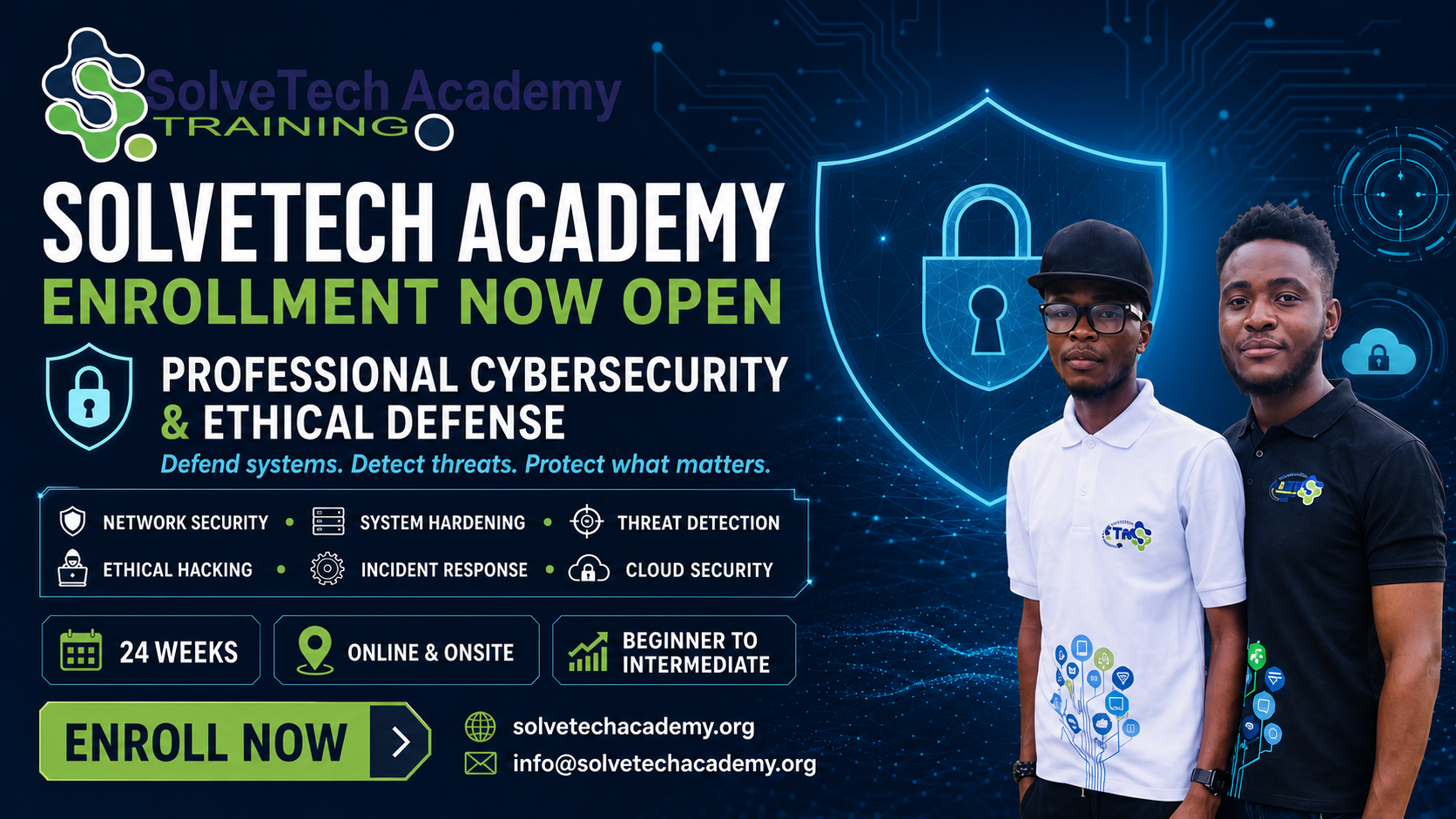
Professional Cybersecurity & Ethical Defense

Professional Cybersecurity & Ethical Defense

Category: Cybersecurity

Instructor: Prof. Nyingcho Philemon

Duration: 24 Weeks (6 Months)

Level: Intermediate

Mode: Online

Price: $130.00

Enroll Now

About This Course

The Professional Cybersecurity & Ethical Defense course is a comprehensive, hands-on program designed to equip learners with the knowledge and practical skills required to protect computers, networks, applications, cloud environments, and organizational data.
Students begin with cybersecurity fundamentals, networking, operating systems, common attack methods, security policies, and risk management. They then progress into Linux and Windows security, access control, cryptography, network defense, vulnerability assessment, ethical hacking, secure application practices, cloud security, monitoring, and incident response.
Learners gain experience using controlled laboratories to identify vulnerabilities, analyze suspicious activity, secure systems, review logs, conduct authorized security assessments, and document findings professionally.
The course emphasizes legal, ethical, and responsible cybersecurity practices. All security testing is limited to systems the learner owns or has explicit authorization to assess.
Students complete practical laboratories, assignments, quizzes, case studies, and a final capstone project involving the assessment and defense of a simulated organizational environment.

What You'll Learn

  • By the end of the course, students should be able to:
  • Explain core cybersecurity principles and terminology.
  • Understand confidentiality, integrity, and availability.
  • Identify common threats, vulnerabilities, and attack methods.
  • Explain networking, ports, protocols, DNS, HTTP, and firewalls.
  • Apply secure Windows and Linux configurations.
  • Manage users, permissions, authentication, and access controls.
  • Explain encryption, hashing, certificates, and public-key infrastructure.
  • Configure network-security controls.
  • Analyze system, application, and security logs.
  • Perform authorized vulnerability assessments.
  • Interpret vulnerability-scanning results.
  • Apply ethical-hacking methodologies in controlled environments.
  • Identify common web-application vulnerabilities.
  • Apply secure coding and input-validation practices.
  • Recognize phishing and social-engineering attacks.
  • Explain malware behavior and defensive controls.
  • Use security-monitoring and threat-detection tools.
  • Develop an incident-response plan.
  • Investigate and document simulated security incidents.
  • Apply backup, recovery, and business-continuity practices.
  • Understand cloud-security responsibilities and controls.
  • Conduct basic digital-forensics procedures.
  • Prepare professional vulnerability and incident reports.
  • Recommend appropriate risk-mitigation measures.
  • Build and present a defensive cybersecurity capstone project.

Career Opportunities

  • Graduates may pursue entry-level and junior positions such as:
  • Junior Cybersecurity Analyst
  • Security Operations Center Analyst
  • Information Security Assistant
  • Junior Vulnerability Analyst
  • Cybersecurity Support Technician
  • Network Security Assistant
  • Information Technology Security Support Specialist
  • Incident Response Assistant
  • Security Monitoring Analyst
  • Governance, Risk and Compliance Assistant
  • Identity and Access Management Assistant
  • Cloud Security Support Associate
  • Junior Digital Forensics Assistant
  • Security Awareness Coordinator
  • Technical Support Specialist
  • Junior Penetration Testing Assistant
  • With additional experience and recognized professional certifications, graduates may progress toward roles such as:
  • Cybersecurity Analyst
  • Security Operations Center Analyst
  • Penetration Tester
  • Ethical Hacker
  • Incident Response Analyst
  • Digital Forensics Analyst
  • Network Security Engineer
  • Cloud Security Engineer
  • Application Security Analyst
  • Governance, Risk and Compliance Analyst
  • Security Consultant
  • Security Engineer
  • Information Security Manager
  • Cybersecurity Architect
  • Graduates may work in technology, banking, healthcare, telecommunications, education, government, defense, retail, consulting, managed security services, and nonprofit organizations.
  • Career outcomes depend on competence, practical experience, portfolio quality, location, certifications, and employer requirements.

Prerequisites

  • Students should have:
  • Basic computer literacy.
  • Basic knowledge of operating systems and files.
  • Basic understanding of the internet.
  • Ability to install and configure software.
  • Access to a reliable computer and internet connection.
  • Willingness to learn networking and command-line tools.
  • Commitment to ethical and lawful cybersecurity practices.
  • Previous cybersecurity experience is not required. Basic networking, Linux, programming, or information technology knowledge is helpful but not mandatory.

Who Should Take This Course?

  • This course is suitable for:
  • Beginners pursuing a cybersecurity career.
  • Students and recent graduates.
  • Information technology support professionals.
  • Network and systems administrators.
  • Software developers interested in application security.
  • Cloud-computing professionals.
  • Professionals transitioning into information security.
  • Business owners responsible for protecting digital systems.
  • Government and nonprofit technology personnel.
  • Aspiring Security Operations Center Analysts.
  • Aspiring ethical hackers and penetration testers.
  • Professionals interested in risk, compliance, and data protection.
  • Anyone seeking practical defensive-security skills.

Certificate Information

Certificate of Completion in Professional Cybersecurity & Ethical Defense
Eligible students will receive a digitally verifiable SolveTech Academy Certificate of Completion.

To qualify, students must:
Complete at least 80% of required lessons.
Submit all compulsory practical assignments.
Complete the required quizzes.
Obtain an overall score of at least 70%.
Pass the final examination.
Complete and pass the cybersecurity capstone project.
Follow all ethical-use and laboratory rules.
Satisfy all academic and administrative requirements.

Course Preview

Curriculum preview

1. Security Principles, Threats and Risk2 lessons
2. Networks, Systems and Access Control2 lessons
3. Vulnerability Assessment and Secure Configuration2 lessons
4. Incident Detection, Response and Forensics2 lessons
5. Governance, Ethics and Security Operations2 lessons

Delivery & certification

Format: Self-Paced

Instructor: Prof. Nyingcho Philemon

Level: Intermediate

Certificate: Certificate of Completion in Professional Cybersecurity & Ethical Defense Eligible students will receive a digitally verifiable SolveTech Academy Certificate of Completion. To qualify, students must: Complete at least 80% of required lessons. Submit all compulsory practical assignments. Complete the required quizzes. Obtain an overall score of at least 70%. Pass the final examination. Complete and pass the cybersecurity capstone project. Follow all ethical-use and laboratory rules. Satisfy all academic and administrative requirements.

Related courses

Introduction to Cybersecurity & Digital Safety

Protect accounts, devices and information from common digital threats.

View course